


Why Ring Tensile Strength Testing Matters The Role of Plasma Welding in High-Quality Chainmail
Why Ring Tensile Strength Testing Matters: The Role of Plasma Welding in High-Quality Chainmail
Meta description: Learn how to identify high-quality chainmail by inspecting welded rings, stainless steel grades, and weave strengthso you avoid unsafe, low-quality chainmail purchases.
When I first started looking for chainmailreal chainmail, not costume-grade stuffI honestly felt overwhelmed. Everything looked shiny in product photos. Every seller promised “premium quality.” But once the package arrived, the truth was often very different. Rings pulled apart by hand. Rust spots after a few weeks. Weaves that looked solid until they were actually worn or tested. If you’ve ever thought, “How am I supposed to know which chainmail is actually safe and durable?” you’re not alone.
Whether you’re buying chainmail for industrial cut protection, food processing, cosplay, or a historical replica, the same question always comes up: how do I tell high-quality chainmail from something that just looks good online? Over timeand after more than a few disappointing purchasesI learned that two things matter more than almost anything else: ring tensile strength testing and how those rings are welded, especially when plasma welding is involved.
This is exactly where a structured inspection approach, like the one behind Aegimesh Chainmail, becomes invaluable. It shifts the conversation from marketing claims to measurable quality.
The real pain points buyers face when evaluating chainmail
Let’s talk about the issues I see again and again when people shop for chainmail.
First, welded rings versus open rings.
This is the big one. Many chainmail products claim to be “welded,” but in reality, the rings are simply butted together. That means the wire ends touch, but they aren’t fused. Under tension, those rings canand often dopull apart. For decorative pieces, that might be acceptable. For cut-resistant chainmail or professional use, it’s a serious safety risk.
I’ve seen gloves marketed for food processing where the rings separated after a light pull test. That’s not just poor quality; it’s dangerous.
Second, confusion about stainless steel grades.
“Stainless steel chainmail” sounds reassuring, but it’s vague. Not all stainless steel behaves the same way. Grade 304 is common and affordable, while 316 offers better corrosion resistance, especially in wet or salty environments. If you don’t know what you’re buying, you might end up with chainmail that stains, pits, or weakens far sooner than expected.
Third, weak or inconsistent weaves.
Even with welded rings, a poorly executed weave can compromise durability. The European 4-in-1 weave, for example, is widely respected for its balance of flexibility and strengthbut only when the ring size, wire thickness, and pattern consistency are correct. Sloppy weaving leads to uneven stress distribution, which shortens the life of the chainmail.
These pain points are exactly why buyers, collectors, and industrial users need a practical way to inspect chainmail beyond surface appearances.
Why ring tensile strength testing matters more than marketing claims
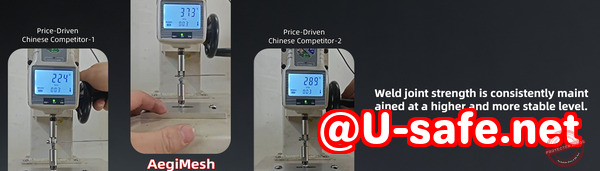
Here’s something sellers don’t often talk about: ring tensile strength testing. In plain terms, this is about how much force a single ring can withstand before it deforms or breaks. It’s one of the clearest indicators of chainmail durability.
When rings are properly weldedespecially using plasma weldingthe joint becomes the strongest part of the ring, not the weakest. Plasma welding allows for precise, controlled fusion of stainless steel without excessive material distortion. The result is a smooth, consistent weld that holds up under stress.
I once compared two stainless steel chainmail samples side by side. Both claimed to be “cut-resistant.” One used butted rings; the other used plasma-welded rings. With a simple pull test, the difference was obvious. The butted rings opened with steady pressure. The welded rings didn’t budge. That’s tensile strength in action.
This is why chainmail quality isn’t just about materialsit’s about how those materials are joined.
How Aegimesh Chainmail helps cut through the confusion
What I appreciate about Aegimesh Chainmail is that it treats inspection as a skill anyone can learn, not a secret reserved for manufacturers. Their guide and inspection approach focus on observable, testable details:
-
Are the rings actually welded?
-
What stainless steel grade is being used304 or 316?
-
Is the wire thickness consistent throughout the weave?
-
Do the ring diameters support strength, not just flexibility?
-
Is the European 4-in-1 weave executed correctly?
Instead of asking you to “trust the brand,” the goal is to help you verify quality yourself. That mindset alone saves money and prevents a lot of frustration.
How I inspect chainmail quality step by step
Over time, I’ve developed a simple routine for inspecting stainless steel chainmail. You don’t need lab equipment. You just need to know what to look for.
1. Check the material first
Ask directly whether the chainmail is made from 304 or 316 stainless steel. If the seller can’t answer clearly, that’s a red flag. For dry environments or cosplay, 304 may be fine. For food processing or industrial use, 316 stainless steel chainmail is usually the better choice due to its corrosion resistance.
2. Inspect the ring welds closely
Look for a smooth, continuous joint where the ring closes. Plasma-welded rings typically have minimal discoloration and no visible gaps. If you can see the wire ends clearly or feel a catch with your fingernail, the ring may not be properly welded.
3. Measure wire thickness and ring diameter
Consistency matters. Variations in wire thickness weaken the overall structure. Smaller inner diameters generally increase strength but reduce flexibility. High-quality chainmail balances both based on intended use.
4. Examine the weave pattern
The European 4-in-1 weave should look uniform, with each ring passing through exactly four others. Misaligned rings or irregular spacing can indicate rushed or low-quality craftsmanship.
Practical tests you can do at home
You don’t need industrial equipment to spot low-quality chainmail.
The simple pull test
Hold a small section of chainmail and apply steady force. You’re not trying to destroy itjust see how it reacts. Open rings will reveal themselves quickly. Welded rings should remain intact.
Corrosion check
Wipe the chainmail with a damp cloth and leave it exposed to air. Poor-quality stainless steel may show discoloration or spotting over time. This is especially important for cut-resistant chainmail used in food handling.
Flex and drape test
High-quality chainmail should flex smoothly without stiff or awkward sections. Uneven stiffness often points to inconsistent ring sizes or weave errors.
These steps help you avoid unsafe chainmail before it ever reaches real-world use.
Matching chainmail quality to real-world use
Not all chainmail needs to meet industrial standardsbut it should meet your standards.
For industrial cut protection, welded rings and proper tensile strength are non-negotiable. Safety depends on it.
For food processing, corrosion resistance and smooth welds matter just as much. Rough joints can trap debris or damage gloves.
For cosplay or historical replicas, durability still counts. Decorative chainmail that falls apart after one event isn’t a bargainit’s a waste.
For collectibles, craftsmanship and material quality affect long-term value. Even display pieces benefit from proper stainless steel and consistent weaving.
Understanding chainmail inspection lets you choose the right product without overpaying or compromising safety.
Common mistakes I see buyers make
One mistake stands out: trusting photos over facts. Lighting can hide open rings. Descriptions can blur the line between “welded-style” and actually welded.
Another mistake is assuming all stainless steel chainmail is equal. It’s not. Grades matter. Welding methods matter. Weave execution matters.
Finally, many buyers skip inspection entirely. A few minutes of checking can prevent months of regret.
Why proper inspection saves money in the long run
High-quality chainmail often costs more upfront, but it lasts longer and performs better. Low-quality products need replacement, repairs, or worsecause injury.
By learning to inspect chainmail quality, you shift from guessing to knowing. That confidence is worth far more than a flashy product listing.
Wrapping it all together
Ring tensile strength testing and plasma welding aren’t just technical buzzwordsthey’re the backbone of durable, safe chainmail. When you understand how welded rings, stainless steel grades, wire thickness, and weave patterns work together, you can evaluate chainmail with clarity instead of doubt.
I highly recommend following these inspection steps to ensure any chainmail purchase meets safety and durability standards. If you want a deeper dive, Aegimesh Chainmail offers a practical reference that helps buyers and professionals separate high-quality chainmail from risky imitations.
Learn more about identifying high-quality chainmail products: https://www.aegimesh.com/
Check out our detailed chainmail inspection guide today and make your next purchase with confidence.
Frequently Asked Questions
How can I tell if a chainmail ring is welded or open?
Look closely at the joint. Welded rings show a smooth, fused connection, while open rings have visible gaps or overlapping ends.
Which stainless steel grade is best for long-lasting chainmail?
Grade 316 offers superior corrosion resistance, especially for food processing or wet environments. Grade 304 is suitable for many general uses.
How do I inspect the weave pattern for strength?
Check for consistency. In a European 4-in-1 weave, each ring should pass through four others evenly, without distortion or gaps.
What are the signs of low-quality or unsafe chainmail?
Open rings, uneven wire thickness, visible corrosion, and inconsistent weaving are all warning signs.
Can decorative chainmail be used for protective purposes?
Generally, no. Decorative chainmail often lacks welded rings and proper tensile strength required for safety.
How do I choose the right chainmail for industrial versus cosplay use?
Industrial use demands welded rings, proper stainless steel grades, and tested durability. Cosplay allows more flexibility, but quality still affects longevity and comfort.
Tags / Keywords:
chainmail quality, welded rings, stainless steel chainmail, cut-resistant chainmail, chainmail inspection, European 4-in-1 weave, chainmail durability




 한국어
한국어  Русский
  Deutsch
  العربية