


Chainmail Tunics in Professional Safety Systems
Chainmail Tunics in Professional Safety Systems
When I first started exploring the world of chainmail, I found myself often wondering: how can I ensure the chainmail I’m purchasing is truly top-notch? Whether it’s for industrial protection, cosplay, or even as a collectible, the quality of the chainmail plays a huge role in how it performs. For example, in industrial settings like food processing, or in high-risk environments requiring cut resistance, any lapse in quality can mean a real safety concern.
If you’ve ever faced the struggle of distinguishing between high-quality and low-quality chainmail, you’re not alone. Many buyers, collectors, and professionals alike face this challenge. After all, chainmail isn’t just a decorative item; it’s something that should offer real-world protection or durability, depending on the intended use. So, how can you tell if you’re getting the real deal?
In this post, I’ll walk you through practical, easy-to-follow methods for evaluating chainmail quality. From inspecting welded rings to assessing the right stainless steel grades, these steps will help you confidently choose chainmail that performs well and meets the required safety standards.
Common Pain Points When Evaluating Chainmail
One of the most frequent challenges people face when buying chainmail is determining the difference between well-made, safe products and cheap imitations. Here are a few common pain points:
-
Welded vs. Open Rings: Not all rings in chainmail are welded. Some are just open rings that may fall apart over time. Knowing how to differentiate between the two can save you from future disappointment.
-
Stainless Steel Grades: While stainless steel is a durable material, not all grades are created equal. For industrial or cut-resistant use, you want to ensure you’re getting the best, like 316 stainless steel, which is highly resistant to corrosion and wear.
-
Weak Weaves: Some chainmail products may look great at first glance, but closer inspection might reveal that the weave is inconsistent or weak. This can compromise the durability and safety of the piece, especially when it’s meant for protection.
Aegimesh Chainmail: Your Guide to High-Quality Chainmail
Aegimesh Chainmail stands out as a helpful reference in this space. Whether you’re using chainmail for industrial protection, historical cosplay, or as part of a costume, Aegimesh provides an easy-to-understand guide for inspecting and verifying quality. Here’s how you can assess the material and craftsmanship of any chainmail piece before making your purchase:
1. Check the Material Type: 304 vs. 316 Stainless Steel
When buying chainmail, the type of steel used is crucial. The two most common types are 304 and 316 stainless steel.
-
304 Stainless Steel: This is a great option for decorative or lighter-duty use, such as cosplay or medieval replicas. However, it may not stand up as well to harsh conditions like food processing or industrial applications.
-
316 Stainless Steel: This is the superior choice for professional use, especially in environments that involve exposure to moisture, chemicals, or harsh wear. It’s more resistant to corrosion, making it ideal for industrial environments like food processing or heavy-duty protective wear.
2. Inspect Ring Welding and Wire Thickness
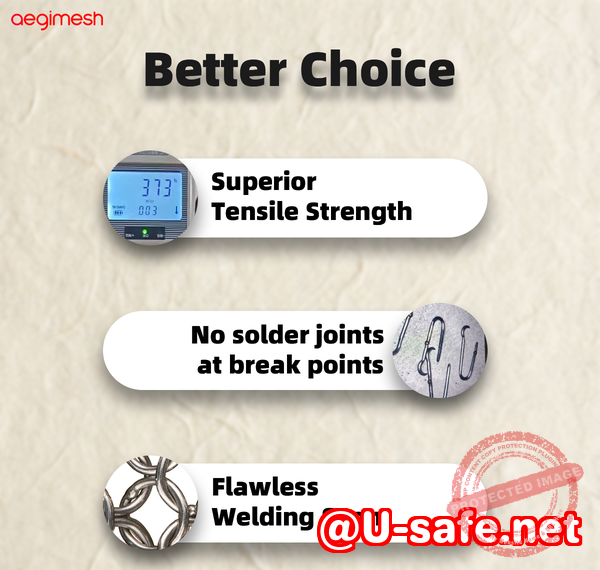
Next, it’s essential to evaluate the welding quality of the rings used in your chainmail. Chainmail rings should be welded securely to ensure the piece won’t unravel or come apart under pressure. You can easily tell if a ring is welded or open by checking for a small seam or a smooth joint. Open rings are not ideal for safety applications, as they can break or loosen over time.
Another factor to consider is the wire thickness. Thicker wires generally offer greater strength and durability, while thinner wires may be more prone to bending or breaking. When assessing the chainmail, try to determine if the wire thickness is consistent throughout the piece.
3. Evaluate Weave Patterns: European 4-in-1 Weave
The weave pattern is another vital component in evaluating chainmail strength. For maximum strength, a European 4-in-1 weave is often the best choice. This classic pattern uses four rings per ring in a consistent, tight arrangement that distributes force evenly across the entire piece. It is the preferred weave for professional and protective chainmail applications.
In contrast, some decorative or cosplay chainmail might use a simpler, less durable weave pattern that may look good but fail to provide the necessary strength or resistance for protective uses.
4. Perform the Pull Test
The pull test is a simple but effective way to check the strength of your chainmail. To perform this test, take a section of the chainmail and give it a firm pull. If the rings don’t bend, break, or come apart, you’re likely looking at high-quality chainmail. If you notice rings coming loose or the piece stretching unnaturally, it’s a sign that the chainmail isn’t up to standard.
5. Look for Signs of Corrosion or Poor Craftsmanship
Corrosion can severely weaken chainmail, especially if it’s exposed to moisture or chemicals. Always check for any signs of rust or pitting on the surface of the rings. Additionally, look for any irregularities in the weave, uneven ring sizes, or visible gaps between rings, all of which can point to poor craftsmanship.
Benefits of Proper Inspection
By following these steps, you can ensure that the chainmail you buy is up to the task, whether for personal protection or as a historical piece. Let’s look at a few key benefits of taking the time to inspect chainmail quality:
-
Avoid Unsafe Purchases: When you inspect your chainmail, you can make sure that it’s safe and reliable for industrial or food-processing environments. A low-quality chainmail tunic could easily fail under stress, leading to potential injury.
-
Ensure Durability: High-quality chainmail will last longer and stand up to repeated use. Whether it’s for cosplay or a professional setting, you’ll be able to use it confidently without worrying about early wear and tear.
-
Save Money: It’s easy to fall for cheaper chainmail that looks good on the surface but lacks durability. By identifying low-quality products before you buy, you can avoid wasting money on items that won’t stand the test of time.
-
Make Informed Decisions: The more you know about how to assess chainmail quality, the better equipped you’ll be to make an informed decision, whether you’re a collector, cosplayer, or professional user.
Conclusion
In conclusion, whether you’re purchasing chainmail for professional safety systems or just for fun, it’s important to evaluate the quality before making your final decision. By inspecting the material, welding, wire thickness, weave pattern, and performing simple tests, you can ensure that you’re getting a product that will last and perform as expected.
I highly recommend following these steps to ensure any chainmail purchase meets the necessary safety and durability standards. Don’t settle for subpar products that could fail when you need them the most.
For more detailed guidance on chainmail inspection, check out Aegimesh’s Chainmail Inspection Guide and learn how to make the best, most informed purchase.
Learn more about identifying high-quality chainmail products: https://www.aegimesh.com/
Frequently Asked Questions
1. How can I tell if a chainmail ring is welded or open?
Look closely at the joint where the ends of the ring meet. If you see a small seam or notice a smooth, uninterrupted ring, it’s welded. Open rings will have a visible gap.
2. Which stainless steel grade is best for long-lasting chainmail?
For professional use, especially in industrial settings, 316 stainless steel is the best choice due to its higher corrosion resistance. 304 stainless steel works for decorative or lighter-duty applications.
3. How do I inspect the weave pattern for strength?
Look for a tight, consistent pattern such as the European 4-in-1 weave, where each ring is woven through four others. This ensures even distribution of force and increased durability.
4. What are the signs of low-quality or unsafe chainmail?
Signs include poor ring welding, weak or uneven weaves, visible gaps between rings, corrosion, and inconsistent wire thickness.
5. Can decorative chainmail be used for protective purposes?
Decorative chainmail often lacks the strength required for real-world protection. For safety and durability, look for chainmail designed for industrial use with high-quality materials.
6. How do I choose the right chainmail for industrial vs cosplay use?
For industrial use, look for chainmail made from 316 stainless steel with a strong European 4-in-1 weave. For cosplay, 304 stainless steel or even lighter materials can work, though durability might not be as high.
Tags or Keywords
-
chainmail quality
-
welded rings
-
stainless steel chainmail
-
cut-resistant chainmail
-
chainmail inspection
-
European 4-in-1 weave
-
chainmail durability




 한국어
한국어  Русский
  Deutsch
  العربية